


CIHS Language Help: How to Communicate with Chinese Hardware Suppliers
Most CIHS exhibitors speak enough English to start a meeting. The real language problem at a 120,000-square-meter hardware fair is not greeting people. It is keeping the conversation specific when the subject turns to minimum order quantity (MOQ), FOB (Free on Board) pricing, certification, lead time, and payment terms. Mandarin is the most spoken first language in the world [1], and its ISO 639-3 code is cmn [2]. A small preparation kit solves most of that.
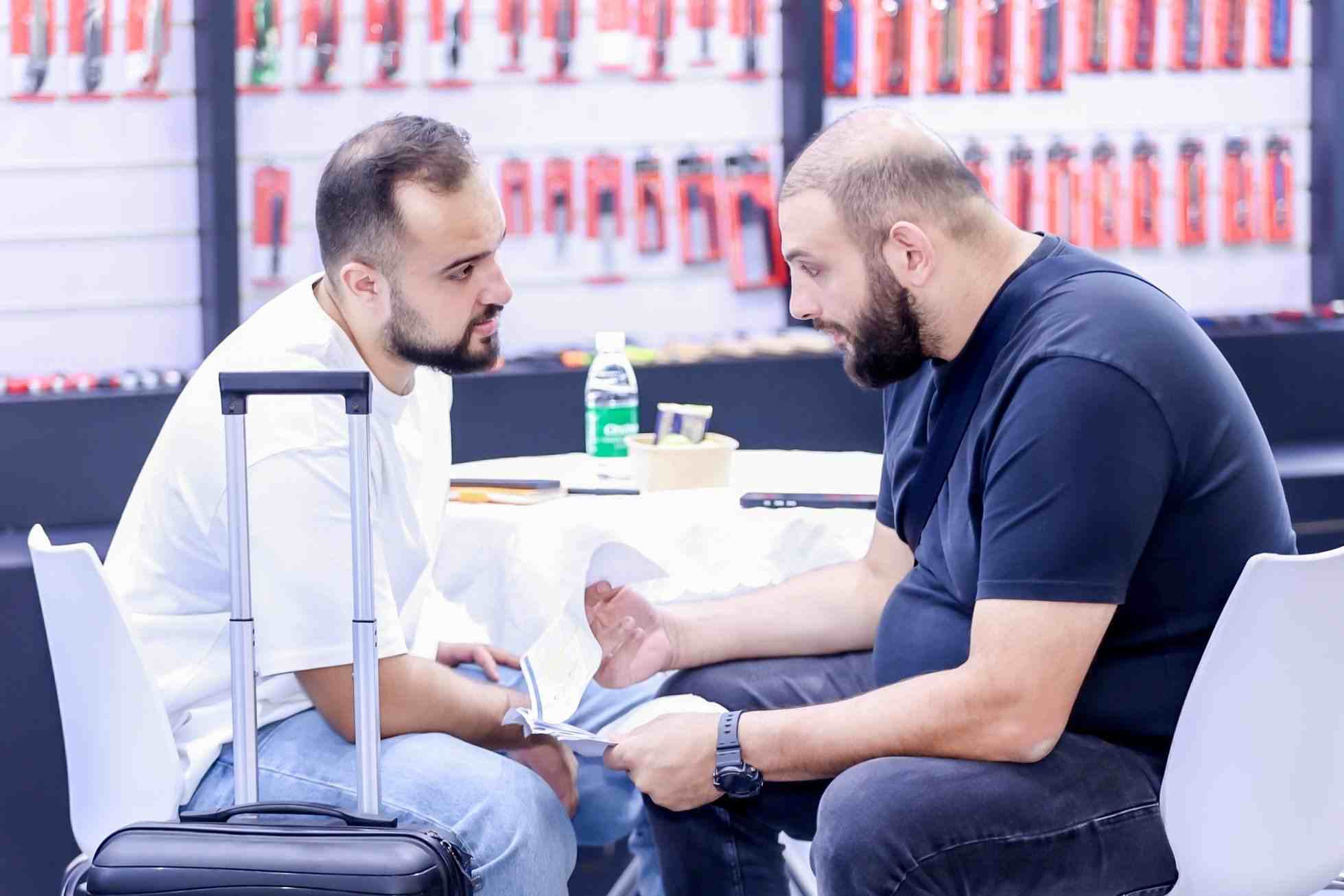
What to Expect at a Booth: English Levels Vary
Export managers and international sales staff are usually the strongest English speakers. Factory owners and production directors may know less English but read numbers, drawings, and sample labels quickly. Trading companies are often more fluent than factories, but a fluent trader is not always the direct manufacturer. Do not judge supplier quality by English level. Judge it by how clearly they answer your written questions. A short greeting and a patient exchange of business cards still set the right tone in Chinese business culture [3].
A Short Mandarin Kit That Keeps Booths Moving
Mainland suppliers write in Simplified Chinese, and most booth conversations are short. A few set phrases cover a large share of your time. Use FOB when you want the price at the Chinese port of loading, before ocean freight.
| Situation | Chinese | Pinyin | What it does |
|---|---|---|---|
| Hello or polite start | 你好 | nǐ hǎo | Opens the booth without pressure |
| Ask MOQ | 你们的起订量是多少? | nǐmen de qǐdìngliàng shì duōshao? | Gets the minimum order quantity |
| Ask for a sample | 可以提供样品吗? | kěyǐ tígōng yàngpǐn ma? | Opens the sample discussion |
| Ask lead time | 交货期多长? | jiāo huò qī duō cháng? | Moves from price to delivery |
| Ask certifications | 你们有什么认证? | nǐmen yǒu shénme rènzhèng? | Covers CE, GS, ISO 9001 and similar questions |
| Factory or trading company | 你们是工厂还是贸易公司? | nǐmen shì gōngchǎng háishì màoyì gōngsī? | Clarifies who you are speaking with |
| Check FOB price | 这是FOB价格吗? | zhè shì FOB jiàgé ma? | Confirms the pricing basis |
| Add WeChat | 请加我的微信 | qǐng jiā wǒ de wēixìn | Builds the follow-up channel |
You do not need perfect tones. In a noisy hall, the written Chinese characters on your phone or printed sheet do more work than pronunciation.
Translation Apps Are Backup, Not the Main Bridge
Download an offline Chinese language pack before you leave. At SNIEC (Shanghai New International Expo Centre), hall Wi-Fi can be crowded, and some international apps are unreliable on China networks. For short English phrases, phone translation is useful. For complicated questions, write in short, plain sentences: subject, verb, object. Avoid idioms, jokes, and multi-part questions. If you need color, material, size, or standard, show the word or a photo instead of letting the translator guess.
When using speech translation, let the phone finish, then look at the supplier. Written follow-up still wins.
WeChat Becomes the Working Language After the Fair
WeChat is the default business channel for most Chinese manufacturers. At the booth, ask for WeChat and send a short message immediately: your name, company, country, and one product requirement. Written Chinese tends to translate more cleanly than a hurried spoken sentence. Keep your notes pinned in WeChat for the projects that matter. This gives you a searchable record of MOQ, lead time, certification, and price. It also makes post-fair follow-up faster.
Before you fly, draft a one-page supplier brief in English and Simplified Chinese. If you want help preparing that brief or sorting which CIHS hall to target, contact the CIHS Buyer Services Team at trista.ming@koelnmesse.cn.
Move Fast by Pushing Every Conversation Into Writing
When language breaks down, use paper. Write down: quantity, target price, FOB port, payment terms, lead time, certification, and sample policy. Confirm each figure by pointing to the number on the page. If a supplier says “no problem,” ask them to write the exact number in Chinese or English. A handshake does not protect an order. A photographed booth note in WeChat does. Bring a small notebook and a black pen. The most efficient buyers at CIHS turn spoken claims into written commitments before leaving the booth.
CIHS Support: Visitor Services, Matchmaking and HBP
CIHS is designed as an international sourcing floor. The Visitor Services Desk can point you to halls, service areas, and buyer resources. If you need more formal language support, the pre-show matchmaking route helps because CIHS receives your product requirements in advance and matches them with exhibitors before you arrive. This reduces the amount of on-site explaining. Some hosted buyer and matchmaking sessions include staff support or quieter meeting spaces where communication is easier.
Across CIHS editions, our team has worked with buyers from 123 countries and regions, and the language questions are remarkably consistent. The fastest buyers bring the same three things: a phrase sheet, a translation backup, and a requirement already written in Chinese.
Your Next Step: Prepare the Bilingual Brief Before You Fly
Build the one-page Chinese-English brief: product category, target market, MOQ, certification needs, and red lines on price or lead time. Bring it to every booth. If you need CIHS registration details, hall planning support, or the Hosted Buyer Programme, contact the CIHS Buyer Services Team at trista.ming@koelnmesse.cn or call +86 21 6390 6161-832.
FAQ
Do I need to speak Mandarin to source at CIHS?
No. Many exhibitors have English-speaking export staff. The issue is not whether you can exchange greetings; it is whether you can confirm technical and commercial details. A phrase sheet, a translation app, and written confirmation cover most situations.
Should I hire an interpreter for the whole fair?
For most buyers, no. A full-day interpreter is useful if you are negotiating large ODM/OEM projects or doing factory-adjacent technical reviews. For general booth sourcing, a lightweight language kit plus written follow-up is usually enough. Interpreter support can be more valuable in private meeting rooms than on the open floor.
What if a supplier does not speak English at all?
Use the printed Chinese phrase sheet and your phone translator. Ask for their WeChat contact and send the requirement in writing. If the product matches, they will typically connect you with an export or sales person who handles international customers.
Is WeChat enough for after-fair follow-up?
Mostly yes, but do not rely on voice notes. Send clear written summaries of what was discussed, including quantities, price basis, certification, and lead time. Request written confirmation. WeChat works well as the working thread; contracts and final purchase terms still belong in signed documents.
Can I negotiate price and terms without fluent conversation?
Yes. Price negotiation at a trade fair often happens around numbers on paper or a phone calculator. Put your target terms in writing, ask for the supplier’s written response, and keep the conversation anchored to specific fields: MOQ, FOB, payment terms, and lead time. This is clearer than informal talk.
References
[1] SIL International, “What are the top 200 most spoken languages?” Ethnologue. [Online]. Available: https://www.ethnologue.com/insights/ethnologue200/
[2] SIL International, “ISO 639-3 Registration Authority: cmn.” [Online]. Available: https://iso639-3.sil.org/code/cmn
[3] International Trade Administration, “China – Market Overview.” [Online]. Available: https://www.trade.gov/country-commercial-guides/china-market-overview
Contact us
-

Ms. Trista Ming
Tel.: +86 21 6390 6161 ext. 832
Trista.ming@koelnmesse.cnMr. Edward Gao
Tel: +86 10 6590 7766-765
Fax: +86 10 6590 6139
Edward.Gao@koelnmesse.cn