


China Hardware Manufacturing: From Cost to Value Creation
China is no longer simply the cheapest address in hardware. For a growing share of professional buyers, it has become the market where the sourcing decision is won or lost on engineering support, certification readiness, production discipline, and cluster-specific capability. We see this shift at CIHS every year: the same buyer who once asked for the floor price now asks to see the quality plan, the reference orders, and the testing reports.

At the same time, unit price still matters. The difference is that more buying teams now treat price as one line in a total value calculation rather than the entire target. That is the core of China’s hardware transition from cost competition to value creation — and it changes how sourcing professionals should prepare, compare, and negotiate.
The End of Pure Cost Competition
For a growing share of buyers, the old question — how low can the price go? — is no longer a complete sourcing strategy. Lowest unit price and lowest landed cost are different things, but the gap has become harder to ignore. A lower Free on Board (FOB) quote can disappear in one rejected container with inconsistent hardness, missing batch traceability, incompatible battery chemistry, or weak documentation. Freight, inspection, rework, returns, and audit failures are now part of the same conversation as the FOB price.
Global trade patterns reinforce the shift. China routinely ranks among the world’s largest exporters of hand tools, power tools, fasteners, and builders’ hardware in UN Comtrade data [2]. WTO trade reviews describe a wider reorganization of manufacturing value chains, with suppliers competing on reliability and compliance rather than cost alone [1].
Several structural pressures push Chinese manufacturers toward value. Labour costs have risen relative to some Southeast Asian producers, environmental enforcement has tightened, and energy efficiency has become a cost driver. Automation, vertical integration, and lean production are the ways stronger factories respond. For buyers, that means asking whether the factory can demonstrate the process behind the quote — not just repeat the price.
Where the Value Is Actually Added
Value creation in Chinese hardware manufacturing concentrates in clusters. Yongkang is known for small hardware and power tools. Danyang specializes in cutting tools. Qidong has a complete power tool supply chain. The Zhejiang fastener belt around Haining and Ningbo concentrates high-volume fastener production. Guangdong’s Pearl River Delta supports electronics-adjacent hardware, while Hebei handles wire mesh. These clusters reduce search time for buyers who know which region leads in their category.
Engineering support has become a key differentiator. Factories that once only produced to sample now offer design-for-manufacturing feedback, alternative materials, tolerance advice, and packaging optimization. For OEM and ODM projects, this can reduce development cycles and prevent expensive changes after tooling has started. Buyers who treat Chinese suppliers as pure capacity miss much of that value.
Production automation is visible across hand tool forging, power tool assembly, fastener heading, and grinding lines. Automation tends to narrow variation and improve repeatability, but it is not proof of quality by itself. The value lies in the factory’s ability to show process capability data, not merely to describe itself as automated.
Compliance as a Value Layer
Documentation used to be the last step. It is now one of the main places where Chinese factories win or lose orders. A supplier that prepares test reports, declarations, and technical files before the buyer asks provides real value; it shortens time to market and reduces the risk of customs detention or marketplace delisting.
For cordless power tools, the EU Battery Regulation [3] and battery safety standards such as IEC 62133-2 [7] have raised compliance complexity. Buyers need more than a certificate; they need to know that the listed cell, BMS, charger, and transport documentation align. For personal protective equipment, Regulation (EU) 2016/425 [4] sets conformity routes that vary by risk category. A naive lowest-price buying decision can fail at the compliance stage.
A factory’s certification stack — ISO 9001 [5] for quality management, product-specific marks, and audit programs — does not guarantee that an order will go well, but it does tell you that the supplier has built processes rather than relying on the owner’s memory. At a trade fair, ask to see report numbers and verify them later; an experienced supplier will not resist that question.
How to Evaluate a Value-First Manufacturer
Here is the scorecard we use when comparing suppliers that claim to have moved beyond price competition.
| Evaluation area | What value looks like | Warning signs |
|---|---|---|
| Engineering and tooling | In-house design, documented tool maintenance | No drawings; “just send photos” |
| Quality system | ISO 9001 [5], controlled calibration, traceability | No records, no incoming inspection |
| Compliance | CE/GS/UKCA evidence, battery or PPE reports [3][4] | Generic certificates with no report numbers |
| Production control | Automated processes and process capability data | Fully manual with inconsistent output |
| After-sales | Named contact, warranty terms, replacement policy | Silence after shipment |
| Reference orders | Similar market references and verifiable track record | No export history or refusal to share |
The pattern is straightforward: value-first suppliers can show evidence, while cost-first suppliers tend to answer with price. That does not mean every factory must be fully automated or hold every certification. It means the gap between the advertised value and the auditable reality should be small.

Where Buyers Can Test the Shift: CIHS
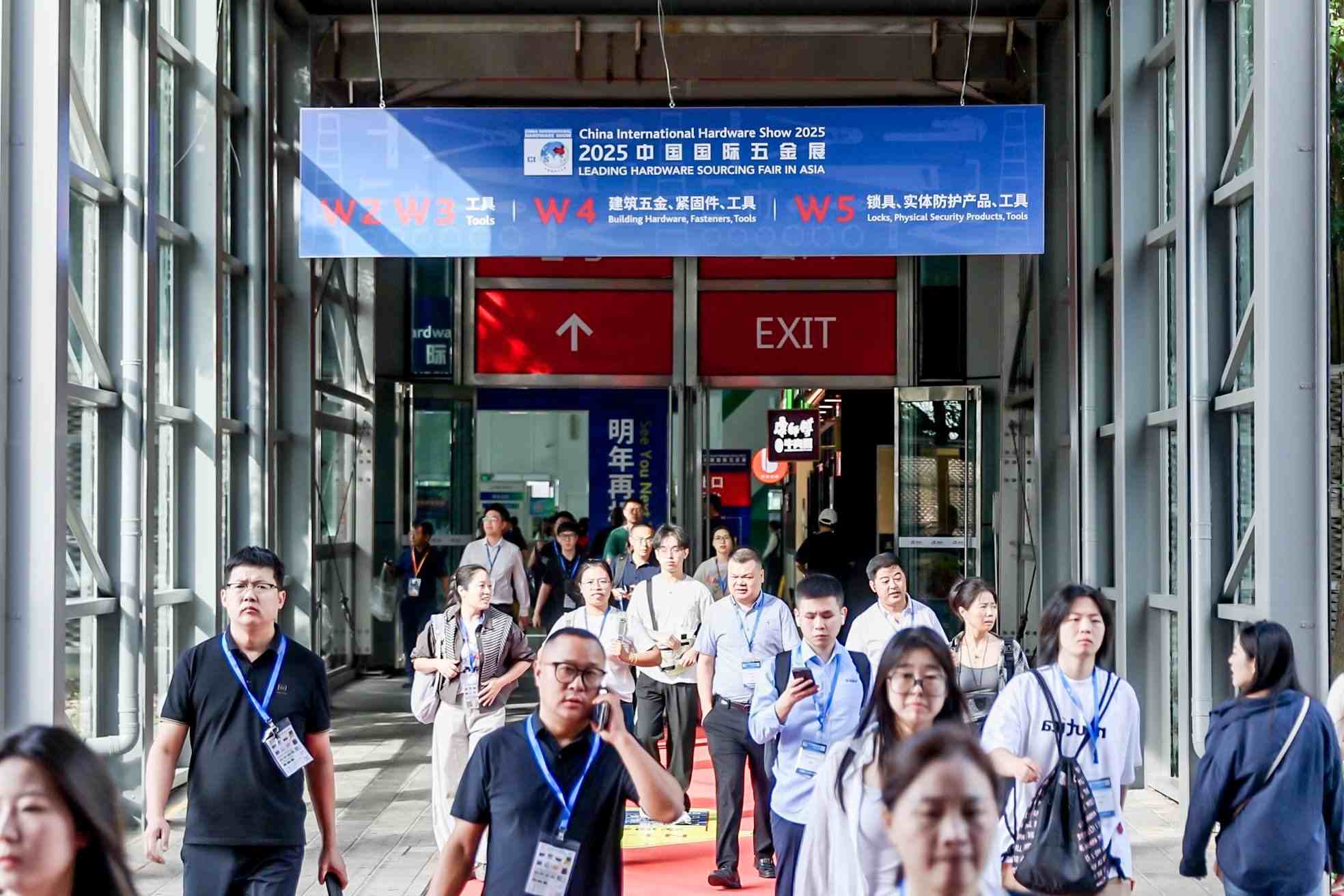
China International Hardware Show is where the shift becomes tangible. In 2025, CIHS brought together 2,977 exhibitors and 77,016 professional buyers from 123 countries and regions across 120,000 square meters at the Shanghai New International Expo Centre [6]. The upcoming edition is planned around more than 3,000 exhibitors and a broad product scope, from hand tools and power tools to fasteners, abrasives, welding, building hardware, garden tools, safety equipment, and smart locking systems.
We use the fair as a benchmark, not as a venue pitch. Buyers who come with a category map, a certification checklist, and a supplier scorecard can compare several factories in one day. The practical advantage of a concentrated event is not that every supplier is good, but that the strong ones are easier to identify because you can see how booths, categories, and factory types are segmented — and ask the same questions across a shortlist.

Plan Your Value-First Sourcing Strategy at CIHS 2026
Reset your China sourcing plan around value. Build a one-page scorecard, include the compliance and quality evidence you need for your market, and use CIHS 2026 to pressure-test a shortlist rather than collect brochures. Contact the CIHS Buyer Services Team at +86 21 6390 6161-832 or trista.ming@koelnmesse.cn to confirm registration and visitor resources.
FAQ
Is China still a cost-competitive option for hardware buyers?
Cost remains important, but the question has changed. For many categories, the stronger calculation is total landed value: product consistency, compliance support, engineering support, lead time, and after-sales response. Some low-priced quotes are still attractive; others compress reality by leaving out certification, inspection, and non-recurring engineering work.
Which Chinese hardware categories offer the clearest value today?
Power tools and cordless platforms, professional hand tools, fasteners with higher-grade requirements, architectural and smart building hardware, abrasives, and personal protective equipment are moving beyond commodity positioning. The most interesting opportunities are often in categories where buyers need documented compliance or ODM development, because that is where factory capability shows quickly.
What should buyers verify before selecting a Chinese manufacturer?
Start with the quality management system, valid product certifications for the target market, report numbers that can be checked, process control evidence, reference orders in a similar market, and the factory’s real engineering or export team. Then confirm packaging, lead time, and after-sales ownership in writing.
Does CIHS help with the value shift, or only with prices?
CIHS concentrates exhibitors so buyers can compare value signals at scale. It works best when visitors arrive with a shortlist, a certification checklist, and a clear target specification; it works less well as a casual walk-through. The fair’s category structure helps buyers move quickly between clusters and supplier types, but the final call still depends on audit and due diligence.
References
[1] World Trade Organization, “World Trade Statistical Review 2025,” Geneva, Switzerland, 2025. [Online]. Available: https://www.wto.org/english/res_e/statis_e/wts2025_e/wts2025_e.pdf
[2] United Nations Statistics Division, “UN Comtrade Database,” 2026. [Online]. Available: https://comtradeplus.un.org/
[3] European Parliament and Council, “Regulation (EU) 2023/1542 concerning batteries and waste batteries,” Official Journal of the European Union, L 191, 2023. [Online]. Available: https://eur-lex.europa.eu/eli/reg/2023/1542/oj
[4] European Parliament and Council, “Regulation (EU) 2016/425 on personal protective equipment,” Official Journal of the European Union, L 81, 2016. [Online]. Available: https://eur-lex.europa.eu/eli/reg/2016/425/oj
[5] International Organization for Standardization, “ISO 9001:2015 Quality management systems — Requirements,” 2015. [Online]. Available: https://www.iso.org/standard/62085.html
[6] China International Hardware Show, “CIHS 2025 Post-Show Report,” 2025. [Online]. Available: https://www.hardwareshow-china.com/
[7] International Electrotechnical Commission, “IEC 62133-2:2017 Secondary cells and batteries containing alkaline or other non-acid electrolytes — Safety requirements for portable sealed secondary cells, and for batteries made from them, for use in portable applications,” 2017. [Online]. Available: https://webstore.iec.ch/publication/61102
Contact us
-

Ms. Trista Ming
Tel.: +86 21 6390 6161 ext. 832
Trista.ming@koelnmesse.cnMr. Edward Gao
Tel: +86 10 6590 7766-765
Fax: +86 10 6590 6139
Edward.Gao@koelnmesse.cn