


Architectural Hardware Exports: Certification and Compliance
Architectural hardware exports are rejected far more often for document scope than for product quality. A panic bar that passes every bench test can stall at a European border because its Declaration of Performance cites a superseded standard edition, and a hinge sold for a fire door can fail tender review because the listing covers the hinge but not the door assembly it was tested in. Certification is a chain of documents, and buyers break that chain at predictable points. This guide sets out which regime governs which product in the main export markets, what each document actually proves, and where supplier paperwork most often stops short.
Which compliance regime applies to your product
The regime follows intended use and destination, not the product line in a supplier catalogue. A stainless steel lever handle sold to a German distributor, the same handle sold to a Texas hardware chain, and the same handle shipped to a contractor in Riyadh can face three different evidence requirements, and only one of them turns on CE marking.
Under Regulation (EU) No 305/2011, a construction product covered by a harmonised standard must carry CE marking supported by a Declaration of Performance [1]. Door and window hardware sits inside that scope. Buyers will see EN 1125 for panic exit devices, EN 179 for emergency exit devices, EN 12209 for locks and latches, EN 1935 for hinges, EN 1154 for door closers, EN 1906 for lever handles and EN 13126 for window hardware named on the declarations they are handed. What matters is not the standard number but whether a safety characteristic is being declared and which assessment system that characteristic falls under.
The United States runs on different logic. There is no single mandatory mark for mechanical architectural hardware. Obligations arrive through locally adopted building and fire codes, which reference listing and installation standards for fire door assemblies [2], through accessibility rules for operable parts [3], and through state chemical disclosure rules such as California’s Proposition 65.
| Market | Legal basis | Evidence you should receive | Who signs it |
|---|---|---|---|
| European Union | CPR (EU) No 305/2011 plus the applicable harmonised standard [1] | Declaration of Performance, CE marking, notified body certificate where the assessment system requires one | Manufacturer; notified body for the aspects it covers |
| Great Britain | UKCA regime and designated standards | UK declaration and UKCA marking, or recognised CE evidence where current rules allow it | Manufacturer; approved body where required |
| United States | Locally adopted codes referencing NFPA 80 [2]; accessibility rules [3] | Listing card, assembly fire test report, operating force data | Listing agency and manufacturer |
| Saudi Arabia and UAE | National conformity programmes operated through online certificate platforms | Product certificate and shipment certificate issued through the national platform | Recognised conformity body |
| Connected or battery powered products | Radio, electromagnetic compatibility, battery and cybersecurity rules in the destination market | Radio test report, declaration of conformity, battery documentation, cybersecurity assessment | Manufacturer; notified body for radio where required |
The practical rule: confirm the destination and the intended use in writing before you discuss price. A supplier who cannot state which regime applies to the model being quoted has not yet understood the order.

What a Declaration of Performance proves, and what it does not
Most buyers read CE marking as an approval. It is a declaration. The manufacturer states the performance achieved for named characteristics, assessed under the system of assessment and verification of constancy of performance that the harmonised standard assigns to those characteristics.
For characteristics tied to safety in use, such as panic function or fire resistance, the standards normally place the product in System 1. A notified body carries out initial type testing and keeps factory production control under surveillance. Other characteristics, corrosion resistance for example, may fall under System 3, where the notified body performs the initial type testing but does not audit the factory afterwards. Both routes produce a legitimate CE mark. They do not produce equivalent evidence.
Two checks catch most of the problems. The notified body number printed with the CE marking should resolve in the European Commission’s NANDO database to a body notified for that product family. A number that returns nothing, or returns a body notified for an unrelated scope, means the declaration is not what it appears to be. The second check is the standard edition cited on the declaration. Editions are revised, and a declaration resting on a withdrawn edition is exactly the document that clears a shipment and fails a tender review two years later.
| Record | Method context | Responsible use | Do not infer |
|---|---|---|---|
| Declaration of Performance for a panic exit device | Declared against the standard edition printed on the document, assessed under the system shown beside the CE mark | Confirms declared characteristics for the models listed in its scope | That other models from the same factory share the same performance |
| Notified body certificate | Issued by a body whose number resolves in NANDO with the correct product scope | Shows factory production control was assessed for the covered characteristics | That the body tested the specific batch you are buying |
| Fire test report for a door assembly | Assembly tested as a complete unit, with named hardware and a described door construction | Supports the classification of that assembly with that hardware set | That the same hinge on a different door core keeps the rating |
| ISO 9001 certificate for the factory | Management system audit, not a product assessment | Shows a quality system exists and was audited | That any individual product meets a technical standard |
| REACH SVHC declaration | Supplier statement checked against the candidate list on the stated date | Starts the substance review for your market entry | That the article is free of every restricted substance |

Why fire-rated hardware is approved as an assembly
The rating belongs to the assembly, not to the part. A fire door is tested as a complete construction: leaf, frame, intumescent seals, hinges, lock, closer and, where fitted, the panic device. The resulting classification describes how long that combination resisted fire and hot gases under the test conditions. Change one hinge for a different model and the classification no longer describes what is installed in the building.
This is why a hardware-only certificate does not answer a fire door question. NFPA 80 governs installation and field modification in the United States, and replacement hardware has to be listed for the application [2]. In Europe the assembly is tested to EN 1634-1 and classified under EN 13501-2, with the permitted hardware sets described in the test report and the field of application document.
Three questions close the gap. Which door assembly was tested? Does the test report name this exact hardware model? Does the hardware’s own listing cover use on that assembly? A supplier who can answer only the second question has given you a part certificate and left the assembly question open. That is the most frequent scope gap in a hardware submission.
Electromechanical and connected hardware add a second compliance stack
A mechanical hinge has one compliance story. An electronic lock has four or five. The moment a product contains a radio, a mains driven motor, a battery or firmware that receives updates, the mechanical standard becomes the first layer rather than the whole file.
In the European Union, radio equipment falls under Directive 2014/53/EU [4], and from 1 August 2025 Delegated Regulation (EU) 2022/30 adds cybersecurity requirements for internet connected radio equipment [5]. Electromagnetic compatibility and low voltage rules apply where the supply or the switching warrants them. The Batteries Regulation (EU) 2023/1542 phases in requirements for portable batteries, including design obligations on removability and replaceability that affect how a lock is built, not only what is written about it [6]. The Cyber Resilience Act (EU) 2024/2847 adds horizontal requirements for products with digital elements, with the main obligations applying from December 2027 [7]. In the United States, radio transmitters need FCC equipment authorisation, and access control units are commonly assessed to UL 294.
One trade-off is worth naming. Using a pre-certified radio module shortens the radio approval path, but the module certificate covers the module. Electromagnetic behaviour depends on the enclosure, antenna placement and power supply, so the finished lock still needs a host assessment. A supplier who quotes only the module certificate has handed you half the chain.
The document set to request before you pay a deposit
Ask for these six items against the specific model being quoted, not against the product family.
| Request | Failure it prevents |
|---|---|
| The standard and edition the product is declared against | A declaration built on a withdrawn edition that clears the factory and fails tender review |
| The assessment system and notified body number | Self-declared CE marking on a characteristic that required a notified body |
| The model coverage page of the declaration or certificate | Ordering a variant that sits outside the certificate scope |
| The full test report with the tested specimen description | Discovering the tested sample differed in material, finish or internal mechanism |
| Material grade and corrosion class with salt spray data | A finish class claimed without supporting test data in coastal or humid projects |
| SVHC declaration and SCIP notification reference | A REACH obligation that blocks onboarding with an EU customer [8] |
Two request lines do most of the work. Both replace a vague ask with a scope question.
| Weak request | Replace with |
|---|---|
| Please send your CE certificate. | Send the Declaration of Performance for model X, the notified body number applied to its assessment system, and the full type test report showing the tested specimen. |
| Fire-rated hardware, please. | Which door assembly was tested, to which classification, and does your listing cover this exact model on that assembly? |
One clause belongs in the contract rather than the email thread: change notification. Sub-supplier changes after approval, a different zinc alloy, a re-sourced spring, a plating process moved to another workshop, are the largest single source of drift between the approved sample and the shipped order. Require written notification and agree in advance which changes trigger a new type test.
Where factory paperwork most often breaks
The failures are consistent enough to check in order.
Entity mismatch comes first. The certificate is held by a trading company or a sister factory, and the seller named on the invoice is neither. Scope drift follows. One declaration covers a family, while the ordered variant differs in a rated component. Superseded editions appear on products that have not changed in a decade, which is precisely where nobody thinks to look. Lapsed surveillance is the quiet one: a System 1 certificate suspended after a failed surveillance visit still photographs well and is worse than no certificate at all.
Finish substitution and fire test substitution are the two technical versions of the same problem. A salt spray class is claimed for a polished finish that the quoted model does not use. A fire report describes a door core that the project will not install. Neither is visible in a catalogue.
None of this means Chinese factories cannot supply compliant architectural hardware. The factories exporting to Europe at volume hold the documents and know their scope limits. The difficulty is that a compliant supplier and an optimistic one look identical from across a show floor, and the documents are the only reliable way to separate them.
A twenty-minute document check you can run at the booth
Ask for the page that lists covered models, not the cover page, and photograph it.
Read the standard edition out loud and write it down.
Note the notified body number exactly as printed.
For fire products, ask which assembly was tested and request the field of application document.
Ask for the salt spray report behind the finish class on the quoted model.
Confirm the legal manufacturer named on the certificate, then compare it with the entity that will appear on the invoice.
Run the NANDO lookup and the edition check after the meeting, before any sample order. Twenty minutes at a booth removes weak candidates faster than a month of email.
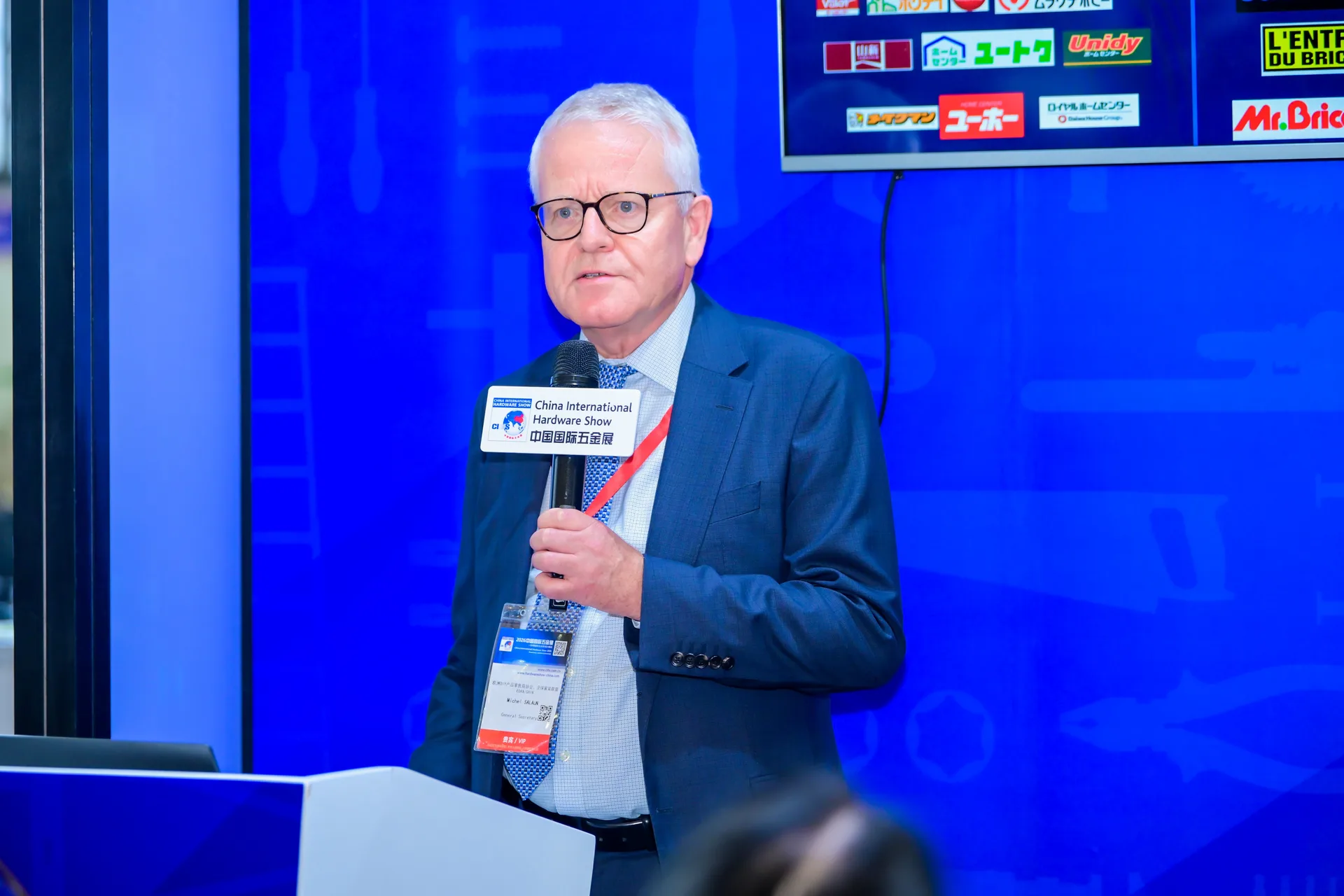
CIHS, organised by Koelnmesse (Beijing) Co., Ltd. and the China National Hardware Association, concentrates roughly 3,000 exhibitors across 120,000 square metres in one venue. That density is what makes the document check a filtering tool rather than a formality: you can compare six suppliers against the same six questions in a single afternoon.
Bring the specification, not just a catalogue request
Before the next edition, send the fields that decide whether a supplier can serve your market at all: product family, destination market, intended use (fire rated, egress or general), the standard and edition you must meet, material and finish class, and whether the item carries electronics or a battery. With those six lines the buyer services desk can point you to the right halls and exhibitor categories, and send the document questions ahead so the answers are waiting when you arrive. Register as a buyer and book a matchmaking slot before you travel.
CIHS Buyer Services Team
Email: trista.ming@koelnmesse.cn
Tel: +86 21 6390 6161-832
FAQ
Is CE marking enough to sell architectural hardware in the EU?
No. CE marking is the visible result of a Declaration of Performance. The declaration has to cite the applicable harmonised standard, state the assessment system, and where a notified body is required, be backed by that body’s certificate. A CE logo printed on a carton with no declaration and no body number tells a buyer nothing. Verify the body number in NANDO and confirm the declared edition is current before accepting the document.
Do I need UL listing to sell door hardware in the United States?
Not universally. Mechanical hardware sold as a replacement part does not carry a general federal marking requirement. The requirement appears when the product forms part of a fire door assembly, where locally adopted codes reference listing and installation standards, or when a project specification calls for a listed component. Accessibility is a separate question: operating force, reach and closing speed apply whether or not the item is listed.
Who is liable if the certificate turns out to be invalid?
In the EU, the manufacturer that signs the Declaration of Performance carries the obligation, and the importer placing the goods on the market has its own verification duties. In commercial terms the buyer usually absorbs the loss: rejected shipments, project delays and relabelling costs are rarely recovered in full. That asymmetry is the reason to check scope before the deposit rather than after the container arrives.
How long does third-party testing take and what drives the cost?
It depends on the test programme, the number of characteristics declared, and whether the product needs continuous surveillance under System 1. A single type test on a well-documented product moves faster than a programme requiring new fire testing of a door assembly, where specimen preparation and laboratory scheduling both gate the timeline. Ask for the test plan and the laboratory’s accreditation, then build your schedule from the plan rather than from a verbal estimate.
What is the difference between ISO 9001 and a product certificate?
ISO 9001 assesses a management system: whether the factory can control its processes consistently. A product certificate or declaration assesses the product against a technical standard and states performance. A factory can hold ISO 9001 and still produce hardware that fails an EN or UL requirement, and a small factory without ISO 9001 can hold a valid type test. Treat them as separate questions and ask for both.
References
[1] Regulation (EU) No 305/2011 of the European Parliament and of the Council of 9 March 2011 laying down harmonised conditions for the marketing of construction products, Off. J. Eur. Union, L 88, 2011.
[2] NFPA 80, Standard for Fire Doors and Other Opening Protectives, National Fire Protection Association, Quincy, MA, 2022.
[3] 2010 ADA Standards for Accessible Design, U.S. Department of Justice, Washington, DC, 2010.
[4] Directive 2014/53/EU of the European Parliament and of the Council on the making available on the market of radio equipment, Off. J. Eur. Union, L 153, 2014.
[5] Commission Delegated Regulation (EU) 2022/30 supplementing Directive 2014/53/EU as regards the essential requirements for network protection, privacy and fraud prevention, Off. J. Eur. Union, L 7, 2022.
[6] Regulation (EU) 2023/1542 concerning batteries and waste batteries, Off. J. Eur. Union, L 191, 2023.
[7] Regulation (EU) 2024/2847 on horizontal cybersecurity requirements for products with digital elements, Off. J. Eur. Union, 2024.
[8] Regulation (EC) No 1907/2006 concerning the Registration, Evaluation, Authorisation and Restriction of Chemicals (REACH), Off. J. Eur. Union, L 396, 2006.
Contact us
-

Ms. Trista Ming
Tel.: +86 21 6390 6161 ext. 832
Trista.ming@koelnmesse.cnMr. Edward Gao
Tel: +86 10 6590 7766-765
Fax: +86 10 6590 6139
Edward.Gao@koelnmesse.cn